
Bootstrapping API project with Phoenix 1.3
Here’s how to create a minimal Phoenix 1.3 setup for API server without HTML, Brunch, Gettext, channels and sessions.
Read more on Phoenix on Rails blog.

Customise your Phoenix HTML Generator
A blog post about using the HTML generator beyond some initial scaffolding with a Phoenix 1.3 how-to example https://medium.com/@mutablestate/customise-your-phoenix-html-generator-d45fecd48683#.i8pqolp3v
Implementing a Naive Enum for Lists in Elixir
Implementing a Naive Enum for Lists in Elixir https://www.youtube.com/watch?v=WORDnCviUu0
Creating Memorable URLs with Phoenix - ElixirCasts.io
In the latest episode of ElixirCasts we create memorable, SEO friendly URLs with Phoenix.
Check it out: https://elixircasts.io/seo-friendly-urls-with-phoenix
Cachex v2.1.0: Now with disk persistance
https://github.com/zackehh/cachex/releases/tag/v2.1.0
The latest release includes the ability to dump your caches to disk and load them from disk, to allow backups and moving between nodes, or automatic bootstrapping from an initial state.
There were also a few fixes with transactions and a few dependency updates, check it out!
Bootstrap 4 & Bootswatch 4 with Phoenix 1.3 rc0
A simple post about Bootstrap 4 & Bootswatch 4 with Phoenix 1.3 rc0
Videos from Elixir Munich's February meetup
Marcus Lankenau on Elixir Macros and Ganesh Balasubramanian shares some experiences he made with Elixir and Phoenix.
https://www.youtube.com/playlist?list=PL83viLKU4ZFWFQ7N91SbB4SBYcPt_rqF3
Setup of Searching, Sorting and Pagination using Rummage
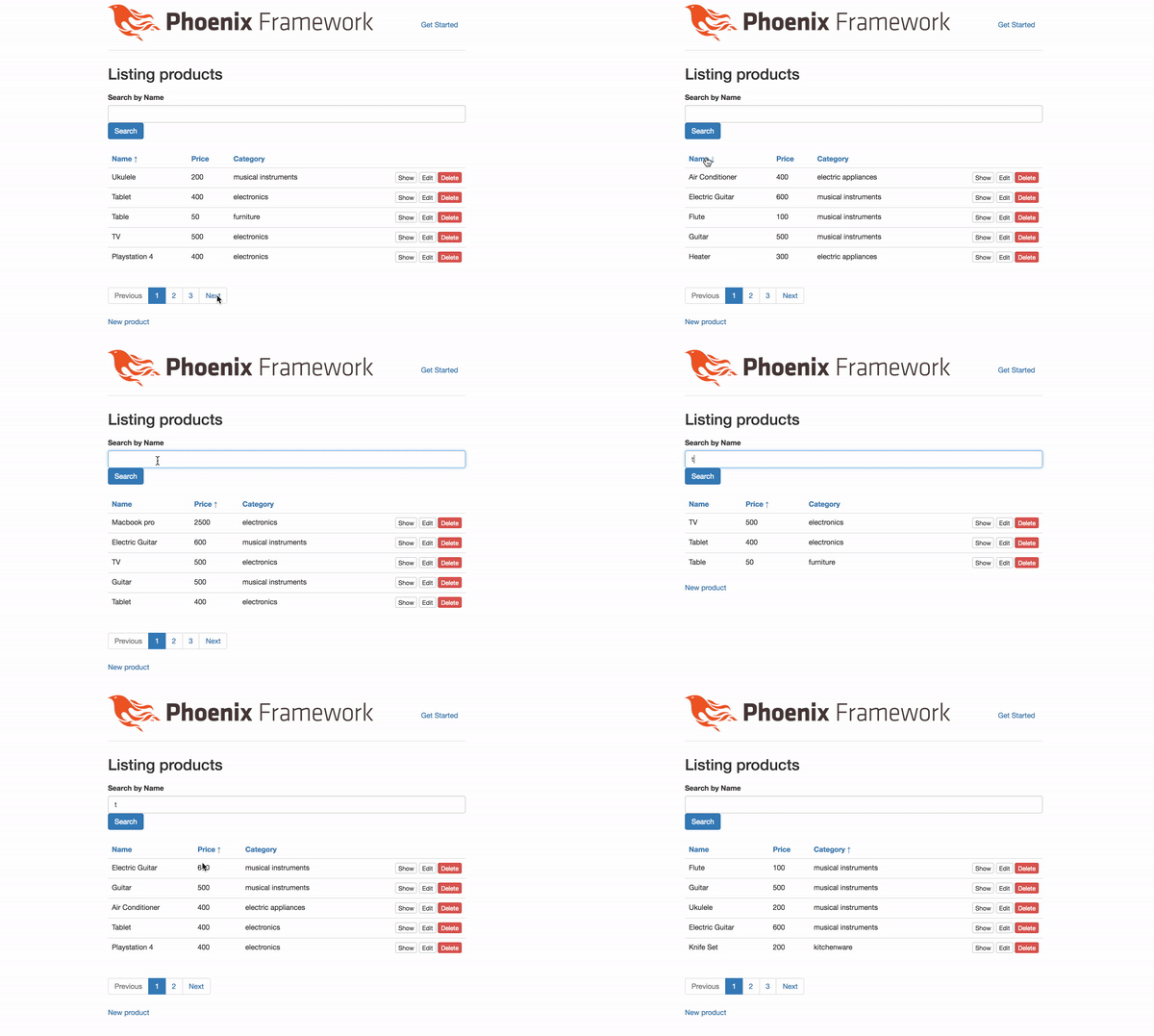
I wrote a library which provides ways to perform Searching, Sorting and Pagination over Ecto queries and Phoenix collections: Rummage. Rummage has been split into two libraries: Rummage.Ecto and Rummage.Phoenix.
Rummage is a Ransack-like library, which is designed in the Elixir way. Which means no defining functions on the models, transparency and configurability!
Rummage comes with a lot of powerful features which are available right away, without writing a bunch of code. Here are a few blogs that talk about how to use Rummage in a Phoenix or an Ecto application:
-
Rummagedemo & basics -
Using
Rummage.Ecto -
Using fully packaged
Rummage.Phoenix(Rummage.EctowithHTML)
Let me know if you have any thoughts on Rummage!
Thank you!
Here’s a little demo:
Elixir - 3 reasons why you should be using it
New blog debuting with 3 good reasons to use Elixir post.
http://www.littlealchemist.io/2017-03-07-elixir-3-reasons-why-you-should-be-using-it/
Making a Mailing Microservice with Elixir and RabbitMQ
A blog post on how engineers at Semaphore created a service that gathers information from multiple sources, and then emails a report that summarizes the data in a useful way to customers using Elixir and RabbitMQ: https://semaphoreci.com/blog/2017/03/07/making-mailing-microservice-with-elixir-and-rabbitmq.html
The engine adding the prerender hint to pages
You might know resource hints (http://caniuse.com/#search=Resource Hint) which are used by browsers to preload/prefetch stuff before it is needed. Since I’ve been started applying the approach into some sites, I was looking for sort of a solution which can gather info from my site and add hints to browsers (yeah, I don’t like manual work), but it looks there is any, hence, I thought of creating an engine https://github.com/sirko-io/engine to achieve my goals. Currently, it only adds the prerender hint (the browser prerenders the page before a user visits it), but I got more plans for the project. If you try to solve the same challenge or you want to use my solution, please, contribute or try it or leave feedback. Any help or advice is priceless. Thanks for your attention!
My first hex package
My first hex package: an ETS and Plug based cache https://github.com/digitalnatives/haphazard
Integrate Your Phoenix Application with Semantic UI and Webpack
A in-depth step-by-step tutorial to integrate Semantic UI framework with Elixir based Phoenix application and Webpack.
Personal notes about Elixir Daze 2017
These are my notes about Elixir Daze 2017 with a summary of all the talks and some slides: http://pedroassumpcao.ghost.io/personal-notes-about-elixir-daze-2017/
Mocking in Elixir on a per-instance basis
My take on mocking on Elixir coming from an OO background - http://evrl.com/elixir/tdd/mocking/2017/03/05/elixir-mocking.html.
Fight Poverty & Hunger w/ Elixir/Phoenix!
Phoenix app to help manage healthy food choices for pantry programs https://github.com/MasbiaSoupKitchenNetwork/open_pantry Early stages but welcome contributors or connections to food programs that might benefit!
action_fallback and contexts in Phoenix 1.3 made my controllers tiny!
I’m amazed by how much cleaner my code is now that I’m using contexts and action_fallback on Phoenix 1.3, so I wrote a bit about it today.
Read here: http://swanros.com/action-fallback-contexts-phoenix1-3-tiny-controllers/
Elixir State Management: Agent or GenServer?
A look at two of the common state management tools in Elixir. http://awochna.com/2017/03/03/elixir-state-management.html
Phoenix 1.3 is pure love for API development
I wrote a bit about the changes that I love about Phoenix 1.3 and why I think this is a great release for API projects.
Read here: http://swanros.com/phoenix-1-3-is-pure-love-for-api-development/