
How Do: Elixir, Functional Fundamentals
In this video I try to explain some of the fundamentals of moving from other programming languages and into Elixir. Going functional was a bit challenging for me and I hope this helps some of y’all.
Exzeitable
In this episode of ElixirCasts we’ll use Exzeitable to quickly add a datatable to an application with full text search, pagination, and automatic refresh.
Building a simple Calendly clone with Phoenix LiveView (pt. 8)
👋🏼 Here’s part eight of the Building a simple Calendly clone with Phoenix LiveView series, in which we’ll finish managing event types adding the corresponding logic for cloning and deleting event types.
https://bigardone.dev/blog/2022/01/31/building-a-simple-calendly-clone-with-phoenix-live-view-pt-8
Happy coding!
When to use the handle_params callback
The handle_params/3 callback is helpful for using the state in the URL to drive the presentation of your LiveView. his is nice because you can share the URL with anyone and see the same LiveView state. https://til.simplebet.io/posts/jhhvhiyczv-when-to-use-the-handleparams-callback
attr_reader has been released.
Defines module attribute getter automatically.
AttrReader
In Elixir, Module variable is often used as a constant. But I didn’t want to bother to define a getter when I wanted to refer to it with Test code etc. If you use AttrReader, you can use it without having to define the getter of the module attribute.
Links
- github: https://github.com/tashirosota/attr_reader
- hexdoc: https://hexdocs.pm/attr_reader/readme.html
Usage
Defines by use
iex> defmodule UseAttrReader do
...>   @foo "foo"
...>   use AttrReader
...>   @bar :bar
...> end

iex> UseAttrReader.foo()
"foo"

iex> UseAttrReader.bar()
:bar
Defines by macro
iex> defmodule UseAttrReaderMacro do
...>   require AttrReader
...>   AttrReader.define @foo
...>   AttrReader.define @bar, "bar"
...>   AttrReader.define @baz, :baz
...> end

iex> UseAttrReader.foo()
nil

iex> UseAttrReader.bar()
"bar"

iex> UseAttrReader.baz()
:baz
ThinkingElixir 085: Computer Vision in Elixir with Cocoa Xu
In episode 85 of Thinking Elixir, we talk with Cocoa Xu about his PhD robotics project and his related Evision project that creates Elixir bindings to the OpenCV library. The project enables computer vision in Elixir much easier by building on existing projects. We learn about the kinds of features this enables and how it can target embedded devices as well. His goal of a clustered, collaborative, hoard of Elixir robots is terrifyingly fascinating! 😄
elixir lunch - a low-key lunch gathering for Elixirists
The first Elixir lunch is happening Feb 11th at 12pm EST!
As a trial run, I’m doing this for lunch time during EST (though you’re welcome to join from another time zone).
Sign up 👉 https://lu.ma/elixir-lunch
Curious why? https://germanvelasco.com/blog/starting-elixir-lunch
Project update: Telemetría
Released an update to Telemetría properly handling multiple clauses and function heads (and introducing :purge_level config param.)
URL [Slug Generator] With Elixir
Learn how to build a human-readable, search engine-friendly URL slugs generator with Elixir.
Introduction to Telemetry in Elixir
Learn what is Telemetry and how to use it in Elixir.
https://blog.miguelcoba.com/introduction-to-telemetry-in-elixir
Elixir Wizards S7E12 - Todd Resudek on the Impact of Elixir
The Elixir Wizards Season 7 Finale is out today! https://smartlogic.io/podcast/elixir-wizards/s7e12-resudek/
Listen in and don’t forget to take our Audience Survey: https://smr.tl/survey
Basic [File Manipulation] With Elixir
Learn how to do basic directories and files creation, open, read, write to files with Elixir.
Mostre como é simples criar uma API com Phoenix
Nesse vídeo passamos por todo o fluxo de código que uma requisição percorre no framework Phoenix e criamos uma API REST com as operações CRUD. Compartilhe com seu colega que ainda não conhece Elixir.
Deploy Elixir Phoenix to Fly with ONE command then set up Continuous Deployment
Learn how to deploy your Elixir Phoenix app to Fly with a single command then set up Continuous Deployment using GitHub Actions. This post has been updated using Chapter 1 and 2 of the Phoenix Deployment Handbook.
Creating Elixir module registry via protocols
https://romankotov.com/articles/elixir-module-registry-via-protocols.html This post describes how to use introspection feature of protocols to create a compile-time module registry.
This approach helps me to tag modules and gather some useful information about them. Using it in my Elixir Smart Home project
It also covers another ways to create a module registry, and some pitfalls that I have faced to make it work.
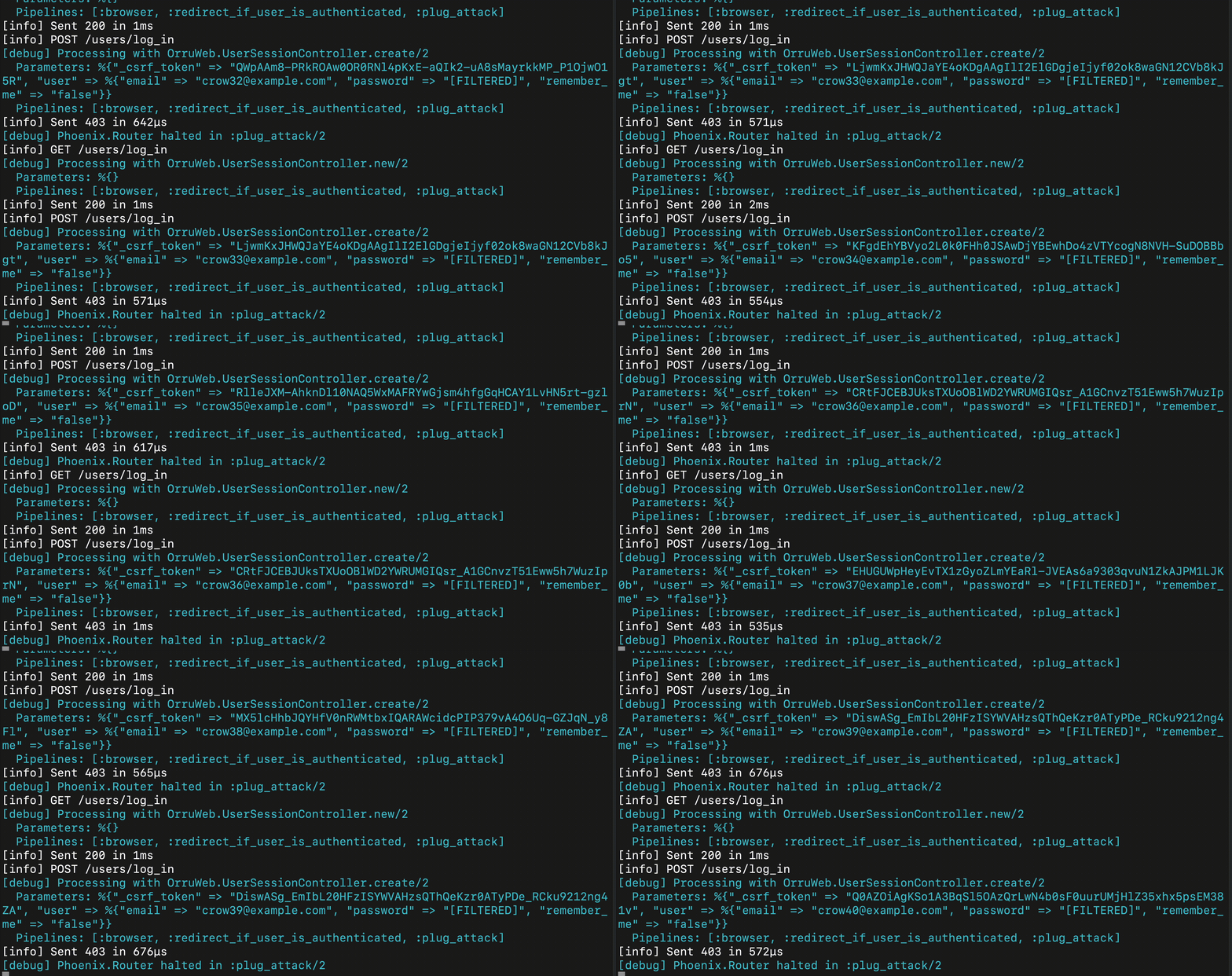
Throttling and Blocking Bad Requests in Phoenix Web Applications with PlugAttack
https://www.paraxial.io/blog/throttle-requests
This post describes how an account takeover attack works, from the perspective of the attacker, and the owner of a victim Phoenix application. After the reader sets up the environment, we introduce PlugAttack, an Elixir library to throttle and ban clients who are abusing the login functionality.
ThinkingElixir 084: LiveBeats with Chris McCord
In episode 84 of Thinking Elixir, We talk with Chris McCord about the LiveBeats project he created. It’s a high-quality, showcase, open source project that highlights new and powerful features in LiveView. LiveBeats is a social music playing application that challenges current ideas about what LiveView is able to do. It uses presence, new JS features, defines reusable Tailwind styled components, includes accessibility and more! An exciting project that people can actually use in addition to being a great community resource. We also get into what’s coming out in Phoenix 1.7 that may interest people getting ready to start a new project!
Formatting GraphQL in Elixir projects
Format GraphQL strings in your Absinthe projects using a custom Elixir formatter plugin. https://maartenvanvliet.nl/2022/01/26/absinthe_formatter/